The Crisis Point in the Introduction
Organization, a SaaS startup with 100 developers and 150 active users, was consuming infrastructure costs.
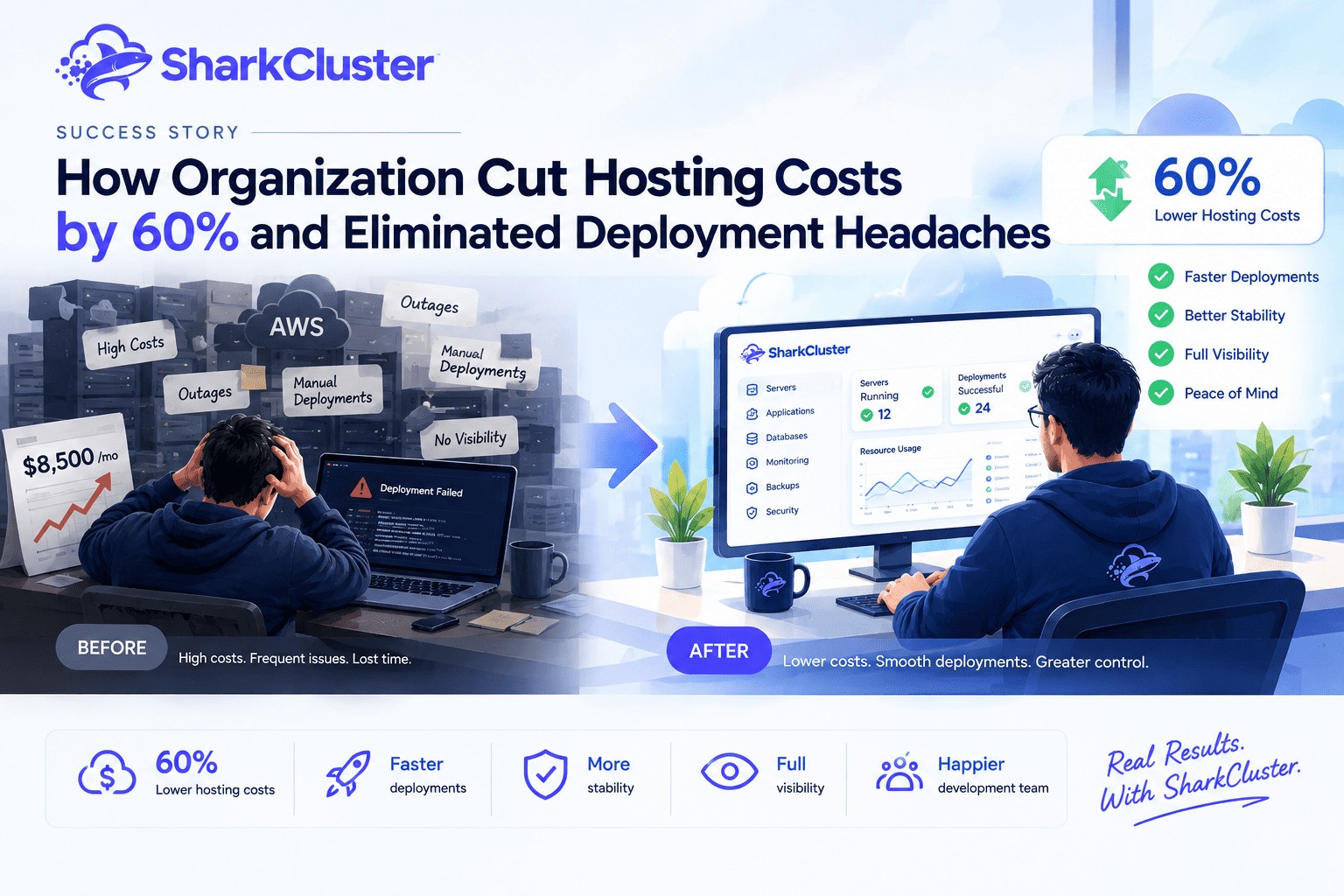
Their $8,500 monthly AWS bill felt bloated. But the financial difficulties weren't the only bad thing.
The real problem was operational chaos.
Every deployment felt like a gamble. Outages happened without warning. In addition, when something went wrong at 2 a.m., the team would fix it for four to six hours before figuring out what was wrong.
The situation is described as follows by their [CTO/Technical Lead]: “We were paying premium prices but getting average results.” Every developer on the team was managing infrastructure for 15 to 20 hours per week rather than building products.
It could not last.
This is how Organization discovered SharkCluster and altered their infrastructure management practices.
The Old Setup: Three Years of Problems
Before SharkCluster, Organization’s infrastructure looked like this:
A load balancer, RDS, CloudFront, and AWS EC2 + Manual deployment scripts + No monitoring dashboard + 24/7 on-call rotation + Tribal knowledge stored in Slack = Expensive chaos
Monthly costs breakdown (OLD):
- EC2 instances: $3,200
- Database from RDS: $1,800
- CloudFront/data transfer: $1,200
- Monitoring & logging (DataDog): $900
- Services other than S3: $400
Total: $7,500/month
However, the actual cost was concealed:
| Hidden Cost | Impact |
|---|---|
| Developer time on ops | 12 devs × 15 hrs/week × $75/hr = $54,000/month in lost productivity |
| Deployment failures | 3–4 rollbacks/month × 4 hours each = $3,600/month cost |
| Outage incidents | 2 major outages/month × $500 customer impact = $1,000/month+ |
| Knowledge silos | Training new devs took 3+ weeks instead of 3 days |
Total real cost: ~$58,500/month (including hidden ops costs)
Specific Problems They Faced
Problem #1: Unpredictable Costs & Surprise Bills
“One month we got a $2,400 bill for unexpected data transfer charges. We had no idea where it came from,” Marcus recalls.
The AWS cost breakdown was a mystery:
- Reserved instances? Different for each environment
- On-demand pricing? Varied by time of day
- Data transfer? Nobody was aware of the situation.
- Pricing calculators? Inaccurate
Result: Finance couldn’t forecast. Budgets got blown. The leadership was dissatisfied.
Issue #2: Deployments Frequently Failed and Took Longer Than 45 Minutes
Their deployment process was:
- Developer pushes code to GitHub (5 min)
- Jenkins picks it up (3 min wait, sometimes 10+ min)
- Runs tests (8–12 min)
- Builds Docker image (8–10 min)
- Pushes to ECR (2–3 min)
- Updates ECS task definition (3–5 min)
- Waits for rolling update (10–15 min)
- Monitors for issues (15+ min manual verification)
Total: 45–80 minutes per deployment
And it failed. Often.
“In a typical month, we’d have 2–3 failed deployments that required manual rollback and troubleshooting,” says [DevOps Lead]. “That’s 8–12 hours of firefighting that could’ve been prevented.”
Problem #3: No Visibility Into What Was Happening
They had separate tools for everything:
- CloudWatch (logs)
- DataDog (metrics)
- PagerDuty (alerts)
- Slack (notifications)
- Spreadsheets (documentation)
“It was like having 5 different information sources and never knowing which one was the source of truth,” Marcus explains. “When something broke, we’d waste 30+ minutes just gathering information from different dashboards.”
Problem #4: Infrastructure Knowledge Was Trapped in People’s Heads
One developer left the company, and suddenly nobody knew:
- Why that particular ALB setting was configured that way
- How to properly scale during traffic spikes
- What the backup strategy actually was
- How to handle the database failover
New developers took 3–4 weeks to get productive. Others took shortcuts, creating more technical debt.
Problem #5: Security & Compliance Gaps
With multiple databases, inconsistent backups, and unclear access controls:
- They had compliance audit failures
- Couldn’t prove backup integrity
- SSH key access wasn’t properly managed
- Database credentials were shared via Slack
The Search for a Solution
By mid-2025, Marcus had had enough. The team evaluated:
Option 1: Heroku
- ❌ $5K/month minimum for their scale
- ❌ Less customizable
- ✅ Simple deployment
Option 2: DigitalOcean App Platform
- ❌ Limited monitoring
- ❌ No built-in database management at their scale
- ✅ Better pricing than AWS
Option 3: Rolling Their Own Kubernetes
- ❌ Would need 1 full-time DevOps engineer
- ❌ Complex to manage
- ✅ Maximum control
Option 4: SharkCluster
- ✅ Deployment in <10 minutes (fully automated)
- ✅ All-in-one monitoring dashboard
- ✅ Transparent, predictable pricing
- ✅ No hidden fees
- ✅ 24/7 developer support
- ✅ Database backups & monitoring built-in
“When I saw SharkCluster’s dashboard and tried the first deployment, I knew we’d found something special. It did in 5 minutes what took us 45+ minutes on AWS.” — Marcus
Migration Day: A Shifting Moment
Phase 1: Preparation
- Set up SharkCluster environment
- Configure database backup and replication
- Create deployment configurations
- Establish alerts and monitoring
Phase 2: Evaluation
- Deploy staging environment to SharkCluster
- Run load tests (peak traffic simulation)
- Migrate read replicas
- Test failover procedures
Phase 3: Go-Live
- DNS cutover (with a 15-minute window and no downtime)
- Final health checks
- Monitor for 48 hours continuously
- Scheduled post-migration optimization
Result: Flawless migration. Zero downtime. Zero data loss.
Results: 60% Cost Reduction + 80% Less Ops Work
Financial Impact
NEW Monthly Costs (SharkCluster):
- App servers (3× 4 vCPU/8 GB/160 GB @ $40/mo + staging/dev envs): ~$1,400/month
- Managed database nodes (primary + replicas): ~$600/month
- Backups & redundancy: ~$350/month
- Logging and monitoring (included with SharkCluster): $0 extra
- Total: ~$2,350/month
Savings: $5,000/month (67% reduction)
$60,000 in annual savings
Plus, they saved on:
- ✅ No more surprise bills
- ✅ Predictable cost per environment
- ✅ Auto-scaling without manual intervention
- ✅ No unused resources
Operational Impact
| Metric | Before | After | Improvement |
|---|---|---|---|
| Deployment time | 45–80 min | 3–5 min | 15–20x faster |
| Deployment failures/month | 2–3 | <1 | 80% fewer |
| Time on infrastructure ops/dev/week | 15 hours | 2 hours | 87% reduction |
| MTTR (mean time to recovery) | 2–4 hours | 10–15 min | 12–24x faster |
| Infrastructure incidents/month | 3–4 | 0.5 | 85% fewer |
| New dev onboarding time | 3–4 weeks | 3–4 days | 10x faster |
Human Impact:
- ✅ Developers spend time building product, not fixing infrastructure
- ✅ No more 2 AM wake-up calls
- ✅ Team morale improved significantly
- ✅ Better work-life balance
Business Impact
“With $60K in annual savings and 80 hours/month of developer time freed up, we could hire 2 more engineers instead of a full-time DevOps person.” — Marcus
In the 6 months since migrating:
- Feature velocity increased 40% — they shipped more features
- Customer satisfaction improved — zero infrastructure-caused outages
- Time-to-market decreased as deployments went from days-long events to minutes
- Focus shifted from firefighting to development — technical debt decreased
The Technical Details: What They Love Most
1. Deployments with a Single Click
Before: 45+ minute build pipeline + manual steps + prayer
After: Git push → automatically deployed in 3–5 minutes ✅
“The first time I pushed code and saw it live in production 5 minutes later, I thought something was broken. It was too fast to be true.” — [Senior Developer]
2. Unified Monitoring Dashboard
No more juggling 5 different tools:
- CPU/Memory/Disk in one view
- Database health alongside app health
- Deployment history with one-click rollbacks
- Real-time logs without context-switching
“I can see our entire infrastructure in 10 seconds. That’s something AWS takes hours to set up and still doesn’t do as clearly.” — Jennifer
3. Database Management
Automated:
- Daily backups
- Point-in-time recovery
- Read replicas
- Automatic failover
“Knowing that our database is regularly backed up and monitored gives us peace of mind. I used to manually check backup logs once a week before. Terrifying.”
4. Pricing That Is Transparent and Predictable
No more:
- ❌ Guessing what you’ll pay
- ❌ Surprise bills
- ❌ Unused resource waste
Just:
- ✅ Starter: 1 vCPU / 1 GB RAM / 25 GB SSD — from $5/month ($0.007/hr)
- ✅ Standard: 2 vCPU / 4 GB RAM / 80 GB SSD — from $20/month ($0.027/hr)
- ✅ Growth: 4 vCPU / 8 GB RAM / 160 GB SSD — from $40/month ($0.055/hr)
- ✅ Performance: 8 vCPU / 16 GB RAM / 350 GB SSD — from $96/month ($0.132/hr)
- ✅ Managed database node — from $5/month
- ✅ No hidden transfer fees — bandwidth included per plan
“Our bill is the same every month, within $50. We can actually forecast.”
5. Developer Assistance
Instead of chatbots, SharkCluster’s support team consists of actual engineers.
“When we had a question about database replication, the support engineer explained it better than AWS documentation ever could. And they responded in 10 minutes, not 2 days.”
Lessons Learned
What Organization Would Tell Other Startups:
1. Don’t Give In to Infrastructure That’s “Good Enough”
“The fact that ‘everyone uses AWS’ does not imply that it is appropriate for you. It’s not a good fit if you spend 20% of your time on operations.”
2. Operational Cost is Real Cost
“Stop counting just the bill. Count developer time. That’s your real expense. We were spending $54K/month in ops work but only paying $7.5K. That ratio was insane.”
3. Transparency Matters
“We can explain our entire infrastructure to any developer on day one. No tribal knowledge. That’s priceless as you grow.”
4. Timing is Important
“Don’t wait until you have a crisis. We should have made this move a year earlier. Every month of delay cost us $5K+ in unnecessary spending.”
Run this on your own VPS
Deploy servers and applications on infrastructure you own, managed from one panel — backups, caching, firewall and monitoring included.