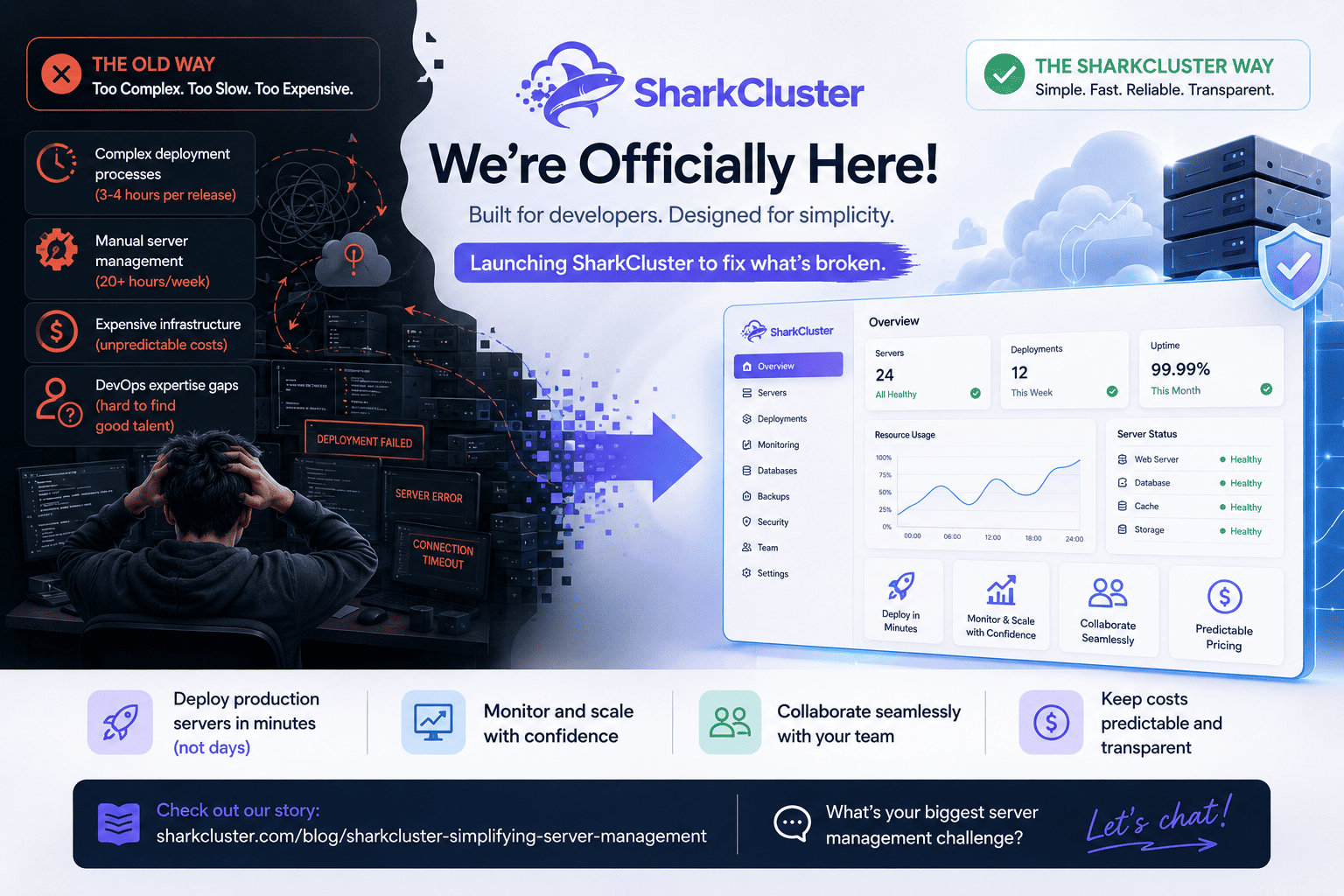

To manage servers, developers shouldn't have to become full-time infrastructure specialists.
For many modern development teams, server management still entails managing cloud providers, SSH sessions, deployment scripts, monitoring tools, firewall rules, backups, databases, and an infrastructure that is becoming increasingly complex. Each new application might introduce yet another layer of operational work.
That complexity slows teams down.
SharkCluster is built to change that.
Developers can deploy applications, monitor infrastructure, manage servers, and optimize resources from a centralized platform rather than manually configuring and maintaining servers for hours. SharkCluster, a cutting-edge server management platform, unifies the essential infrastructure operations into a single, streamlined environment.
The objective is clear: devote more time to product development rather than infrastructure management.
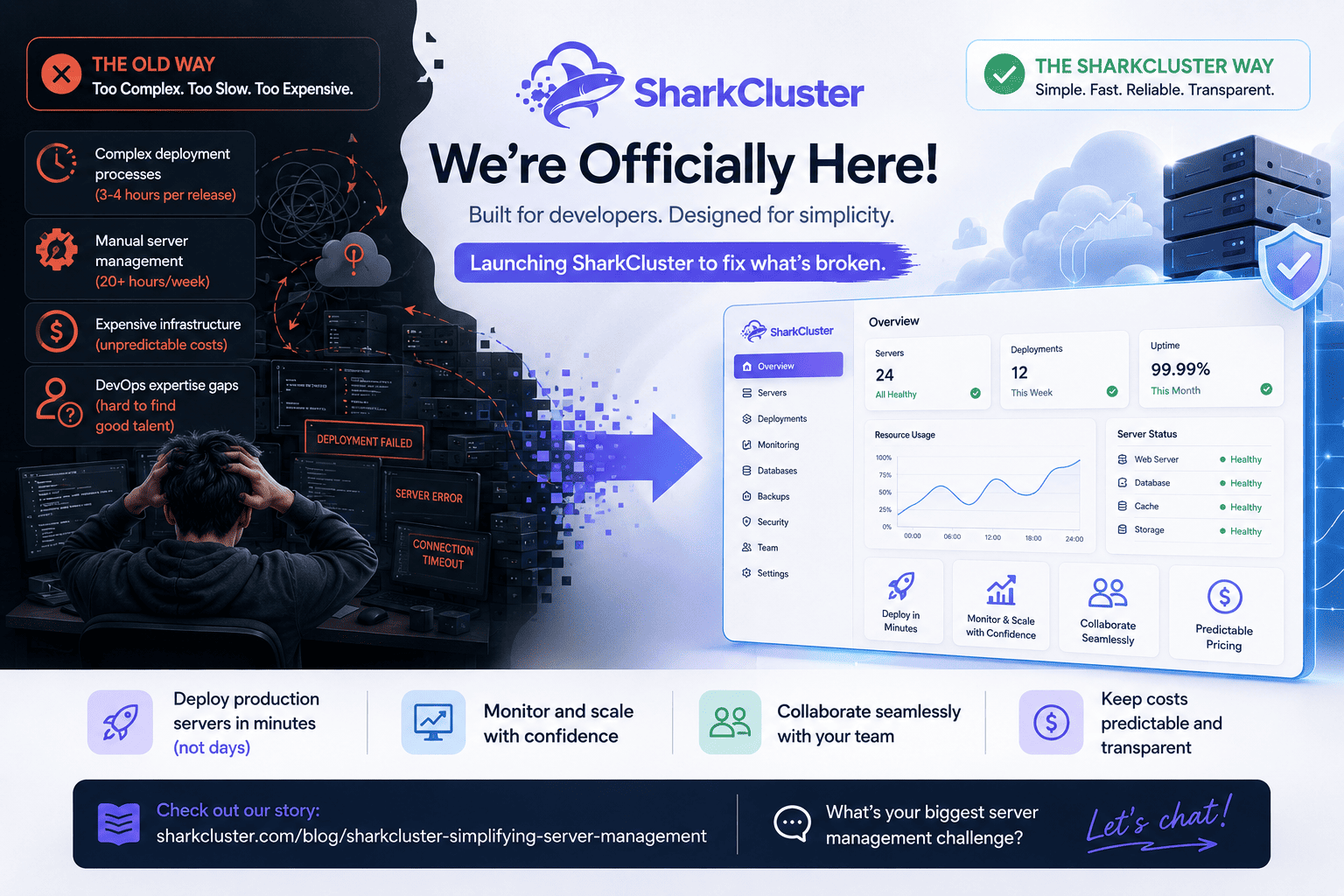
The Server Management Problem
Infrastructure has become easier to access, but not necessarily easier to use.
Using cloud platforms, a server can be set up in a matter of minutes. After the server has started up, the challenge begins.
Developers must still consider:
- Server configuration
- Application deployment
- Operating system updates
- Security and firewall rules
- Backups and recovery
- Performance monitoring
- Resource utilization
- Database management
- SSL certificates
- Scaling
- Access management
- Troubleshooting
These responsibilities may seem manageable for a small project. However, infrastructure responsibilities can quickly become a significant operational burden as applications expand.
Manual labor is inefficient.
A collection of command-line tools, scripts, dashboards, and third-party services are frequently used in traditional server management.
To deploy an application, a developer might use SSH, use a different dashboard to check resource usage, set up backups somewhere else, and use different security or monitoring tools.
Each individual tool may work well. The problem is the fragmentation.
Teams end up spending time switching between systems instead of managing infrastructure through a consistent workflow.
This also creates another problem: operational knowledge becomes difficult to share.
Onboarding a new developer can take longer when server configuration relies heavily on individual scripts or manual commands. It is possible for troubleshooting to become dependent on the initial environment configuration.
The Hidden Cost of Infrastructure
Server management has a cost beyond the cloud bill.
There is also the cost of developer time.
Developers won't have time to work on product development, customer enhancements, testing, or innovation if they handle repetitive infrastructure tasks for hours each week.
Startups may see their valuable engineering resources diverted from growth as a result.
It may necessitate spending more time maintaining client infrastructure for agencies.
Fragmented infrastructure management has the potential to introduce operational complexity across teams and environments for larger organizations.
The solution isn't necessarily to eliminate control. Developers continue to require adaptability and visibility.
Simplify the work without hiding the infrastructure is the better strategy.
Developers should be able to use infrastructure management on a daily basis because it should be simple to use and powerful enough.
How the SharkCluster Works
SharkCluster is based on a single fundamental idea:
Developers should be able to use infrastructure management on a daily basis because it should be simple to use and powerful enough.
SharkCluster provides a centralized environment for common server management workflows rather than requiring teams to develop their own collection of scripts and tools.
1. Make everyday infrastructure tasks easier to do
Server management involves many repetitive operations.
SharkCluster aims to simplify these operations into workflows so developers can concentrate more on meaningful work rather than remembering commands.
Server operations, backups, monitoring, and deployment are all consolidated into a single location by the platform's essential infrastructure capabilities.
2. Reduce operations' complexity
Multiple servers, applications, environments, and providers can make up modern infrastructure.
By providing a centralized infrastructure management strategy, SharkCluster makes it simpler to comprehend what is running and how resources are being used.
When an application moves from a single server to a more distributed environment, this is especially helpful.
3. Give Developers Visibility
Visibility is just as important as automation. Automation is helpful.
Developers need to know if a problem needs to be fixed, how well their servers work, and how well resources are used.
With real-time infrastructure monitoring, teams can make decisions instead of waiting for users to report problems.
4. Make infrastructure easier to access
Every developer doesn't want to spend their day in a terminal.
SharkCluster maintains the underlying infrastructure's accessibility to technical teams while offering a management experience that is more approachable.
As a result, developers can manage infrastructure in a workflow without making every server task a manual DevOps project.
Key SharkCluster Features
SharkCluster provides a unified server management experience by combining a number of important features.
Deployment by Click
A prolonged sequence of manual commands should not be required for deployment.
Developers can speed up the process of moving applications from development to production by making use of SharkCluster's deployment workflows.
The objective is to reduce errors, speed up deployment, and make it more consistent.
Teams can save time on infrastructure preparation with streamlined deployment, whether they are launching a new application or updating an existing environment.
Take a look at the features of the SharkCluster platform to see how they can simplify your infrastructure workflow.
Monitoring Constantly
Knowing that a server is running is not enough.
Teams require visibility into the utilization of resources and infrastructure health.
SharkCluster's monitoring capabilities enable developers to monitor vital server information, allowing them to identify potential issues, comprehend resource consumption, and respond before minor issues turn into more serious operational issues.
Instead of checking servers repeatedly by hand, teams can quickly understand their infrastructure by using centralized monitoring.
Collaboration in Teams
A single person typically handles infrastructure management.
It's possible that technical teams, developers, DevOps engineers, and system administrators all require access to the same environments.
By giving teams a common place to manage infrastructure and comprehend their environments' current state, a centralized server management platform can facilitate collaboration.
This makes it easier for a group to share infrastructure operations and reduces the reliance on individual information.
Lowering of Costs
When resources are not utilized to their full potential, cloud infrastructure can become costly.
Ineffective decisions regarding the infrastructure, oversized instances, services that aren't needed, and servers that aren't being used can all lead to gradual increases in operational costs.
With SharkCluster, teams can better decide how to allocate resources and get a better understanding of their infrastructure.
The objective isn't simply to reduce the number on a cloud bill. It's to help teams understand what they're paying for and use their infrastructure more efficiently.
See the SharkCluster Pricing to explore the available plans and infrastructure management options.
Who Can Benefit From SharkCluster?
SharkCluster is designed for teams that want more control over their infrastructure without adding unnecessary operational complexity.
Startups: Reduce Infrastructure Overhead
Startups must act quickly.
Due to the limited resources of early-stage engineering teams, developers may be required to build and maintain the product's infrastructure.
SharkCluster can help reduce the amount of repetitive server administration required to keep applications running.
Instead of building a complex internal infrastructure management system from the beginning, startups can use a centralized platform and focus more engineering effort on their product.
Agencies: Manage Multiple Client Environments
Agencies often have a different infrastructure challenge: scale across clients.
One project may require a simple application server while another may need databases, backups, monitoring, and multiple environments.
Managing each client manually can become increasingly difficult.
Agencies can organize infrastructure operations more consistently with the aid of a centralized server management workflow, making it simpler to manage multiple projects without developing a distinct procedure for each client.
Businesses: Scale without Overcomplicity
Numerous servers may be used by larger businesses to support a variety of applications and environments.
Consistency and visibility become crucial at this scale.
SharkCluster can provide teams with a centralized approach to server management, helping reduce fragmented workflows and making infrastructure easier to monitor and operate as environments grow.
What's Next for SharkCluster?
Server management is constantly evolving.
Infrastructure platforms must adapt to new technologies adopted by development teams.
The roadmap of SharkCluster aims to make modern infrastructure management simpler for developers.
Future enhancements will continue to prioritize automation, observability, deployment workflows, infrastructure management, and developer experience.
On the other hand, the process of picking the right platform is ongoing.
Community feedback matters.
The developers who use SharkCluster on a daily basis are in the best position to determine which workflows are challenging, which routine tasks should be automated, and which capabilities would simplify infrastructure management.
We'd love to hear about a server management workflow you'd like to see simplified.
Build More. Manage Less.
Infrastructure is essential to every modern application, but managing infrastructure shouldn't consume the majority of your engineering team's time.
The future of server management isn't about removing developers from infrastructure.
It's about giving them better tools.
SharkCluster is a platform that combines deployment, monitoring, server operations, collaboration, and infrastructure visibility for modern development teams.
SharkCluster is ideal for launching your first production application, managing infrastructure for multiple clients, or scaling an established platform because it was designed to simplify server management.
Are you willing to put in more time building servers rather than managing them?
SharkCluster — Simplify server management. Deploy faster. Build more.
Run this on your own VPS
Deploy servers and applications on infrastructure you own, managed from one panel — backups, caching, firewall and monitoring included.