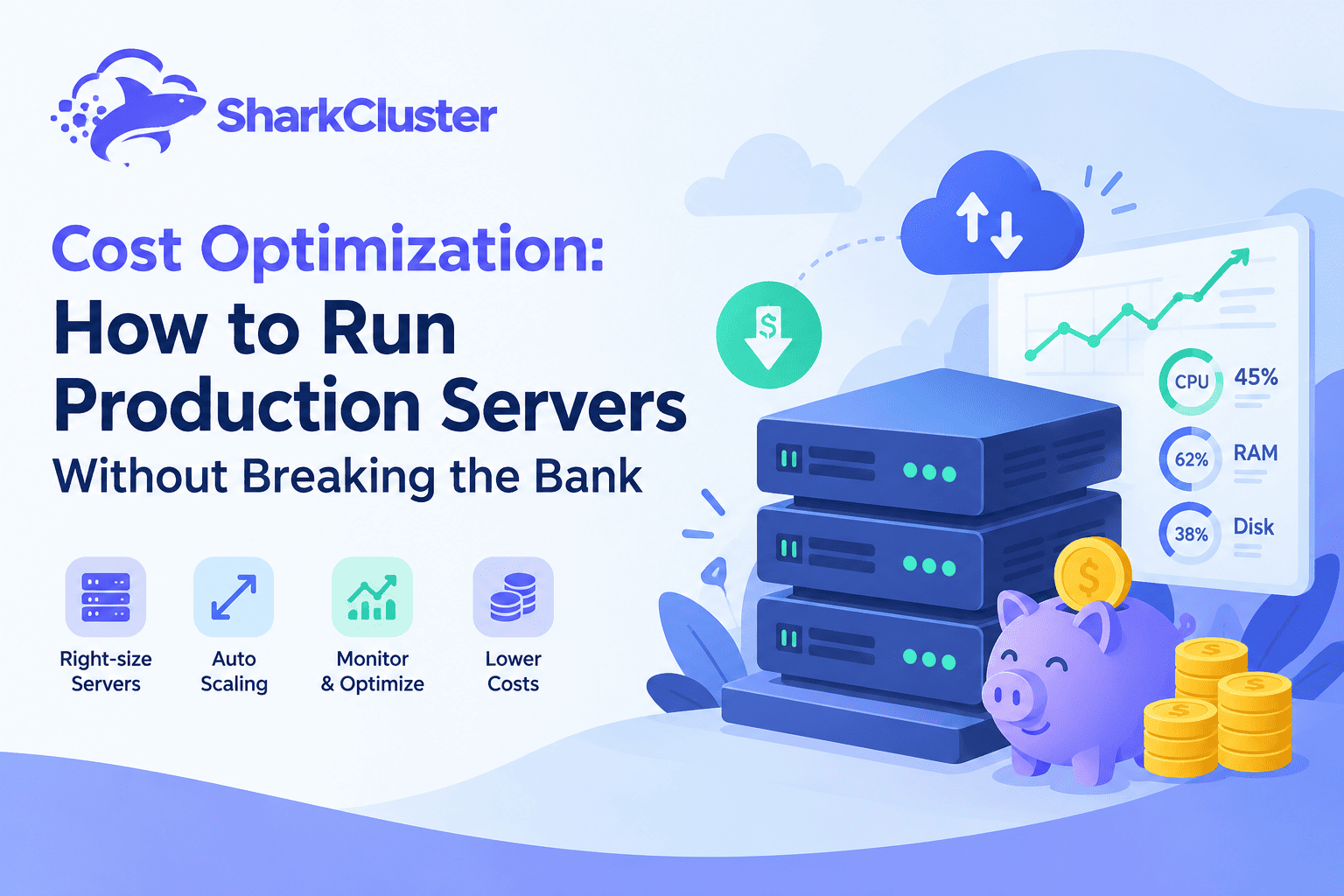

How to Reduce Costs by Running Production Servers on a Budget
Running production infrastructure is not only about keeping applications online. As applications grow, infrastructure costs can quickly become one of the biggest challenges for development teams, startups, and businesses.
The problem is rarely that a single server is too expensive. More often, costs increase because resources are oversized, idle infrastructure stays running, workloads are not monitored closely, or teams choose pricing models that do not match how their servers are actually used.
Teams that are attempting to reduce server costs shouldn't just want to save money; rather, they should ensure that each CPU core, gigabyte of RAM, gigabyte of storage, and hour of server time is being used effectively.
The good news is that optimizing costs does not necessitate sacrificing performance or dependability. You can create production environments that are both cost-effective and dependable with the right infrastructure strategy, automation, and monitoring.
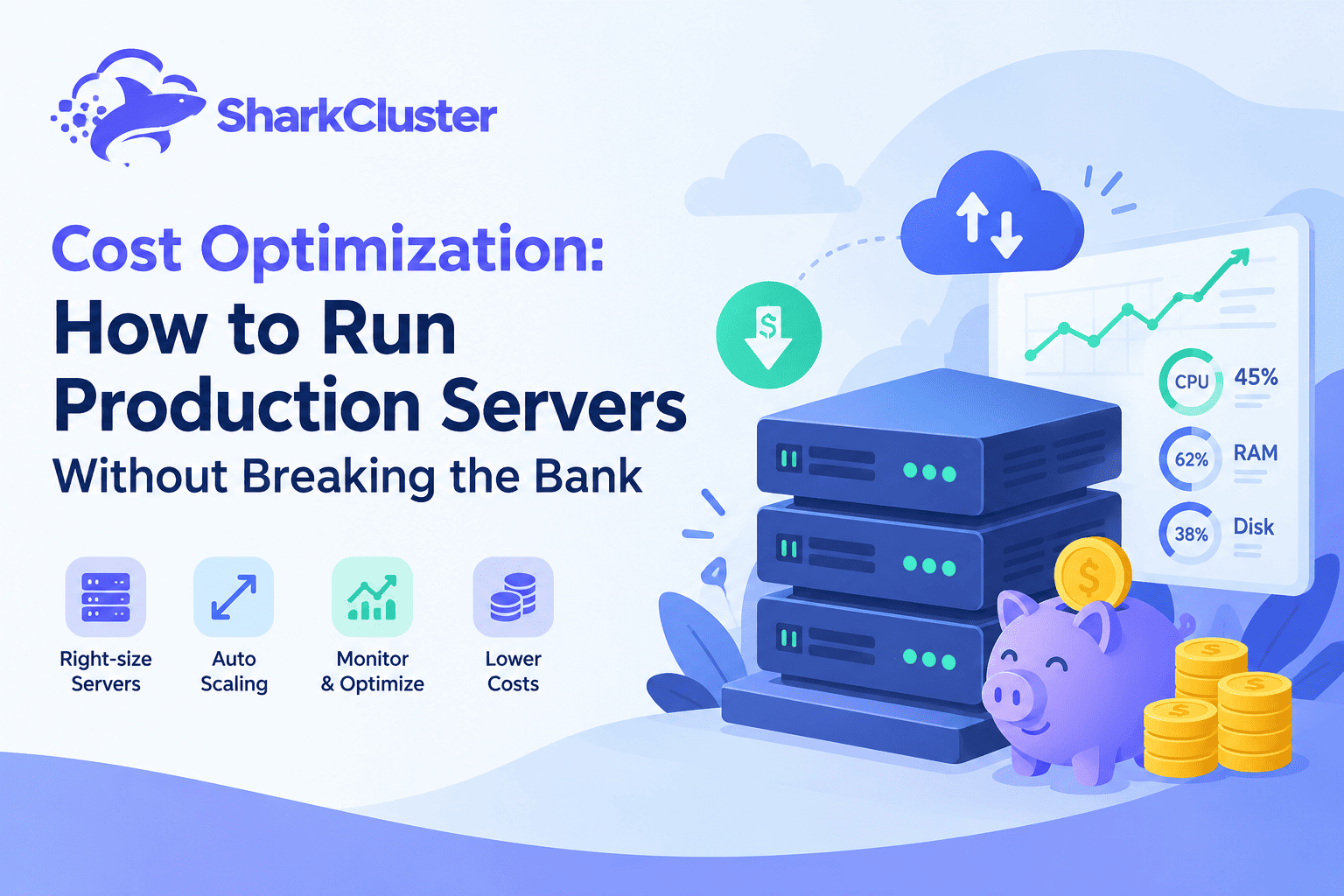
Where Infrastructure Spending Is Wrong: The Cost Problem
Because infrastructure is dynamic, it can be difficult to control spending on servers and the cloud. Applications change, traffic changes, the number of development environments grows, and sometimes temporary resources become permanent.
In the FinOps Foundation's 2025 State of FinOps report, respondents who manage more than $69 billion in cloud spending rank workload optimization and waste reduction as their top priorities.
That is a strong indication that infrastructure efficiency remains a major operational concern.
Common sources of unnecessary infrastructure spending include:
- Oversized servers that consistently operate far below capacity
- Continuous operation of development and staging servers
- Unused or forgotten infrastructure
- Excessive storage and backup retention
- Applications running on inefficient server configurations
- Lack of monitoring around CPU, memory, disk, and bandwidth
- Paying On-Demand rates for predictable workloads
The first step toward reducing these costs is visibility. Without measurement, infrastructure cannot be optimized.
1. Size your infrastructure correctly.
Choosing resources based on actual application requirements rather than anticipated maximum usage is one simple way to cut server costs.
Provisioning a large server because an application may require additional resources in the future is a common error.
Take, for instance, a production application that runs on:
- 8 vCPUs
- 32 GB RAM
- 320 GB storage
The infrastructure may be significantly overloaded if monitoring reveals that the application typically uses only 2–3 vCPUs and 8–12 GB of memory.
Instead of upgrading the server automatically, analyze the actual workload.
Look at:
- Average CPU utilization
- Peak CPU utilization
- Memory consumption
- Disk usage
- Disk I/O
- Network traffic
- Application response times
- Database workload
It is not the objective to operate a server at 100% utilization. For spikes in traffic and unexpected workloads, production systems need room to grow.
A better approach is to identify a configuration that handles normal workloads comfortably while leaving enough capacity for predictable peaks.
Right-sizing should be continuous
Infrastructure requirements change.
In six months, a program that currently requires 4 GB of RAM may require 16 GB. On the other hand, when a campaign comes to an end, a brief spike in traffic may vanish.
Instead of treating the initial server configuration as permanent, regularly review the infrastructure.
2. Auto-Scaling Best Practices
Right-sizing helps control baseline infrastructure costs, but applications with unpredictable traffic need another strategy: scaling.
Auto-scaling allows infrastructure capacity to be increased when demand is high and decreased when demand is low.
On the other hand, add more servers whenever CPU reaches 70% is not sufficient to describe auto-scaling.
Scaling that isn't set up right can actually cost more.
Start with meaningful signals such as:
- CPU utilization
- Memory utilization
- Request rate
- Queue depth
- Response latency
- Active connections
- Application-specific metrics
Because the workload is waiting on external services, a web application may experience a large number of requests while CPU utilization remains relatively low. CPU alone would not provide enough information to make a scaling decision.
Scale gradually
Avoid aggressive scaling rules that continuously create and remove resources.
Instead:
- Define a reasonable baseline.
- Identify the metrics that indicate real demand.
- Add capacity when sustained demand crosses a threshold.
- Remove capacity only after demand has remained low for an appropriate period.
- Examine the outcome.
Scaling policies should also include safeguards so a sudden traffic spike does not create an unexpectedly large infrastructure bill.
3. Monitoring & Alerting: Visibility Before Optimization
You cannot effectively reduce server costs without understanding how your servers are being used.
Monitoring should provide a clear view of infrastructure health and resource consumption.
At minimum, monitor:
CPU
High CPU usage can indicate insufficient capacity, inefficient application code, background jobs, or traffic growth.
Memory
Memory pressure can lead to swapping, application instability, and poor performance. Low memory utilization over long periods can also indicate an oversized server.
Disk
Monitor both capacity and I/O. Running out of disk can cause production failures, while excessive storage retention can increase costs unnecessarily.
Network
Unexpected traffic can increase infrastructure costs and may also indicate configuration problems, abuse, or unusual application behavior.
Alerts
When alerts that can be taken are generated, monitoring becomes much more useful.
Instead of receiving notifications for every temporary CPU spike, create alerts around sustained conditions that require attention.
For instance:
- CPU above a threshold for a sustained period
- Memory consistently approaching capacity
- Disk usage reaching a critical level
- Server becoming unreachable
- Unusual traffic patterns
This turns monitoring from a dashboard into an operational tool.
4. Compare Server Costs and Billing Models
Another important aspect of infrastructure optimization is pricing strategy. On-Demand pricing lets you adjust to temporary, unpredictable, or still-under-evaluation workloads.
You only pay for the amount of space you use, not for a long time.
Commitment-based pricing can provide significant savings for workloads that are predictable.
In place of the standard On-Demand pricing, AWS, for instance, provides Reserved Instances and Savings Plans. According to AWS, EC2 Reserved Instances can provide savings of up to 72% compared to On-Demand pricing, depending on the configuration and commitment.
Savings Plans similarly exchange a usage commitment for lower pricing. AWS currently documents savings of up to 66% for Compute Savings Plans and up to 72% for EC2 Instance Savings Plans.
The important lesson is not simply always reserve servers.
Instead, match the pricing model to the workload.
| Workload | Suitable approach |
|---|---|
| Temporary development environment | Flexible / On-Demand |
| New application with uncertain growth | Flexible pricing |
| Stable production workload | Commitment-based pricing may make sense |
| Highly variable workload | Flexible capacity + scaling |
| Interruptible batch workload | Consider lower-cost interruptible capacity |
Do not commit to long-term capacity simply because the discounted price looks attractive. A discount on infrastructure you no longer need is still wasted spending.
5. Don't Forget Storage and Backups
Compute is only one part of infrastructure costs.
Storage can quietly grow over time because of:
- Old backups
- Database dumps
- Application logs
- Uploaded files
- Temporary deployment artifacts
- Unused snapshots
Create retention policies for logs and backups.
For instance, rather than storing every backup indefinitely, develop a retention plan based on your recovery needs.
The same principle applies to application logs. Keep enough history for troubleshooting and compliance requirements without allowing logs to grow without limits.
6. How SharkCluster Helps With Cost Optimization
SharkCluster is designed to make server management more transparent and easier to control.
Instead of forcing developers to manage infrastructure entirely through separate provider dashboards, SharkCluster brings server deployment and management workflows into one platform.
Its cost-oriented approach includes:
Transparent Server Pricing
SharkCluster displays server pricing before deployment, helping you understand the expected infrastructure cost before creating a server.
The platform's pricing model separates server/provider costs from optional usage, with provider costs billed according to the selected infrastructure.
Provider Comparison
Different workloads have different infrastructure requirements. Comparing available providers and server configurations can help you choose an appropriate balance between resources, location, and cost.
Resource Visibility
It is simpler to identify infrastructure that is consistently underutilized or approaching capacity when server resource usage is monitored.
Automated Server Management
By automating repetitive server operations, the likelihood of leaving running redundant infrastructure because no one remembered to manage it is reduced.
Backups and Infrastructure Management
It is simpler to comprehend which servers, applications, and resources require attention with centralized management.
The goal is simple: make decisions about infrastructure based on actual usage rather than on assumptions.
7. A Simple Real ROI Example
Consider a small production application running on a server costing $80 per month.
Suppose monitoring shows:
- CPU averages around 25%
- Memory averages around 30%
- Traffic is relatively stable
- There are no significant increases each day.
The team finds that a smaller server that costs $50 per month can comfortably handle the application's normal traffic while maintaining sufficient headroom after analyzing the workload.
The formula is easy to understand:
Before optimization:
$80 × 12 = $960/year
After optimization:
$50 × 12 = $600/year
Annual infrastructure reduction:
$960 − $600 = $360/year
In this illustration, that equates to a decrease of 37.5 percent in the monthly cost of the server.
Now, suppose that the same optimization is applied to 20 servers of comparable size:
$360 × 20 = $7,200/year
The important point is that this saving did not require reducing application functionality. It came from comparing actual workload requirements to infrastructure capacity.
In addition, monitoring provides the information necessary to rescale the infrastructure in the event of future workload growth.
8. Build a Continuous Cost Optimization Process
Cost optimization should not be treated as a one-time maintenance task.
Infrastructure optimization ought to be incorporated into your standard engineering workflow because a production environment undergoes continuous change.
A useful monthly evaluation might include:
- Review server utilization — Identify consistently underused and heavily utilized servers.
- Review inactive infrastructure — Look for servers, applications, storage, and backups that are no longer required.
- Review traffic patterns — Understand when and why workloads increase.
- Review pricing models — Check whether stable workloads could benefit from commitment-based pricing.
- Review scaling policies — Make sure infrastructure scales according to meaningful application signals.
- Review alerts — Remove noisy alerts and add alerts for conditions that actually require action.
- Document changes — Record why infrastructure was resized or a pricing strategy was changed.
This creates a feedback loop where infrastructure continuously evolves with the application.
Reduce Server Costs Without Sacrificing Performance
The goal of cost optimization is not to run the cheapest possible infrastructure.
It entails operating the appropriate infrastructure for the workload.
Oversizing can waste money. Undersizing can damage performance and reliability. Poor monitoring can hide both problems. And committing to the wrong pricing model can lock you into unnecessary costs.
A better strategy combines:
- Right-sized infrastructure
- Intelligent scaling
- Continuous monitoring
- Actionable alerting
- Appropriate pricing models
- Storage and backup management
- Regular infrastructure reviews
With SharkCluster, developers can bring these server-management activities into a centralized workflow and make infrastructure decisions with greater visibility.
Measure what you actually use and then optimize based on that information to reduce server costs while maintaining the dependability of your production applications.
Ready to build a more cost-efficient production environment? Explore SharkCluster and choose infrastructure based on your application's real requirements.
Run this on your own VPS
Deploy servers and applications on infrastructure you own, managed from one panel — backups, caching, firewall and monitoring included.